Industry Intelligence
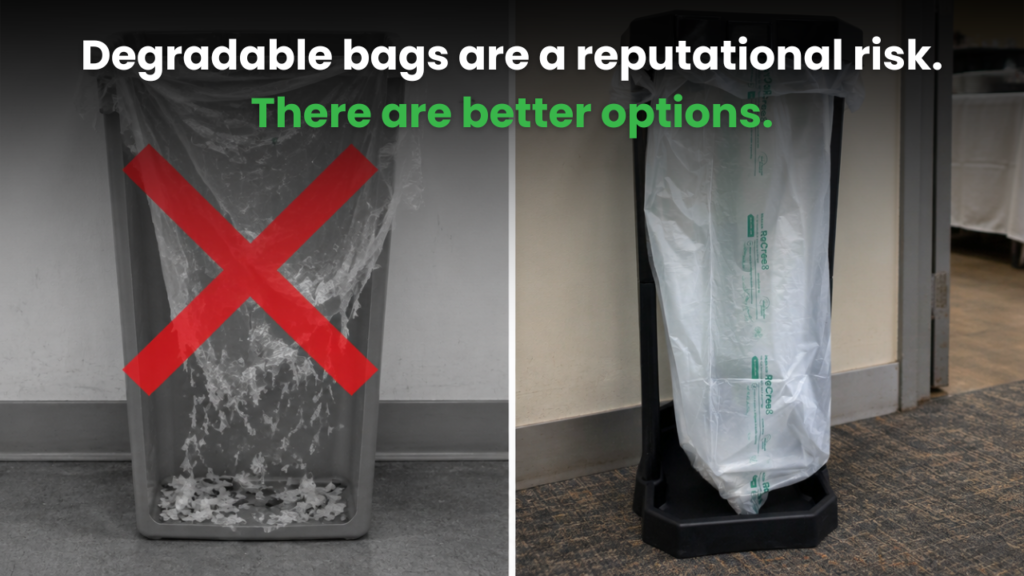
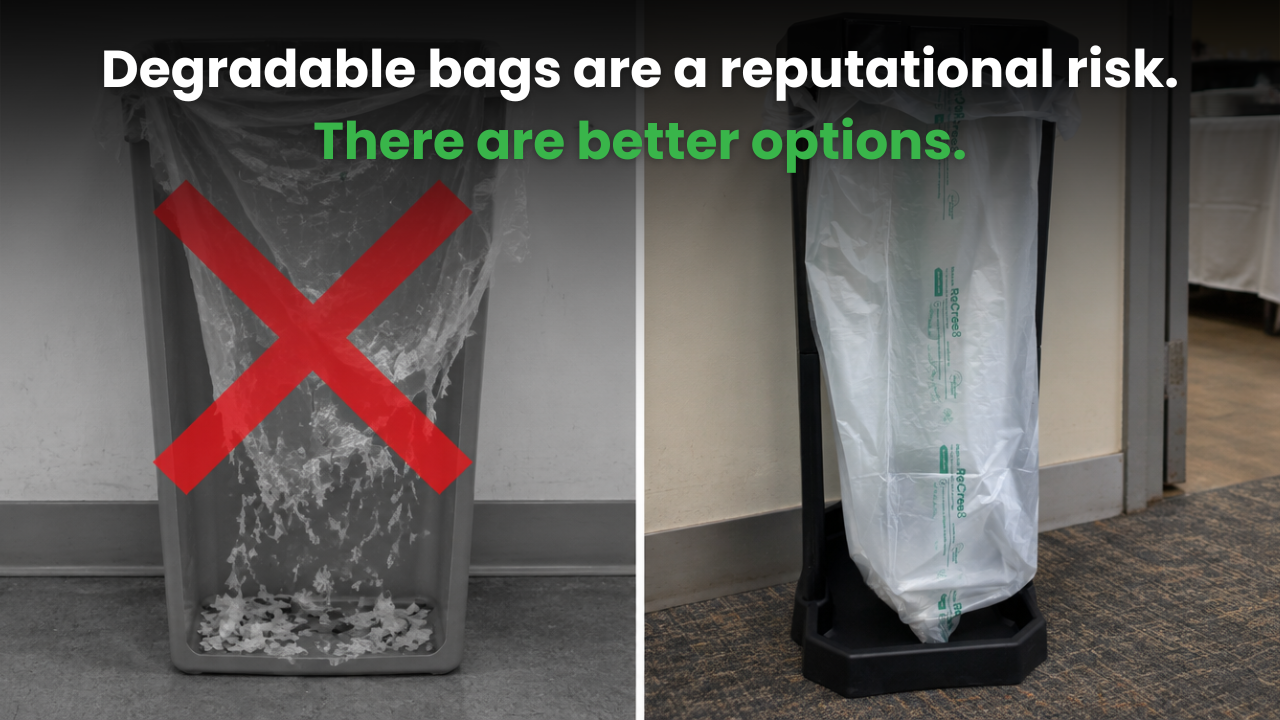
Oxo-Degradable Bags in Australia: The Regulatory and Reputational Risk Your Venue Can’t Afford to Ignore
Multiple Australian states have moved to ban or restrict degradable plastics. Here’s what that means for venues, councils, and cleaning contractors — and the certified PCR alternatives that replace them at competitive price points.
For years, oxo-degradable and degradable bin liners were marketed to Australian venues, councils, and cleaning contractors as the sustainable middle ground — a product that would eventually break down and disappear, making the waste problem somebody else’s problem.
The science disagreed. And now, so does Australian regulation.
If your organisation is still purchasing degradable bin liners — or if you’re a distributor or cleaning contractor still supplying them — there are two risks sitting in your supply chain that are only growing: a regulatory risk as bans expand, and a reputational risk that’s increasingly difficult to manage once a client or auditor starts asking questions.
What’s actually wrong with oxo-degradable bags
Oxo-degradable plastics are conventional plastics — typically polyethylene — with a chemical additive that causes them to fragment into smaller and smaller pieces when exposed to heat, oxygen, or UV light. The marketing positioned this fragmentation as biodegradation. It isn’t.
What actually happens is that the plastic breaks into microplastic particles that persist in soil, waterways, and the food chain indefinitely. The original plastic doesn’t disappear — it becomes smaller and harder to collect or manage. Research published by CSIRO and other bodies has been consistent on this point for over a decade.
Compostable or biodegradable claims attached to these products are, in most cases, misleading. The Australian Competition and Consumer Commission (ACCC) has made this explicit in its guidance on environmental claims, noting that degradable plastics are one of the areas of highest greenwashing risk under Australian Consumer Law.
Regulatory status — Australian state and territory bans
- Queensland — Banned oxo-degradable plastic products under the Waste Reduction and Recycling Act
- South Australia — Banned oxo-degradable plastic products
- Western Australia — Banned from 1 January 2023 under the Environmental Protection (Plastic Products) Regulations
- ACT — Banned under the Plastic Reduction Act 2021
- Victoria, NSW, Tasmania, NT — Bans on single-use plastics extending progressively; oxo-degradables under active regulatory scrutiny
The direction of travel at the federal level is toward a nationally consistent ban. Organisations purchasing or supplying degradable bin liners in any Australian jurisdiction should be reviewing their supply chain now.
The reputational risk is arguably more immediate
The regulatory timeline varies by state. The reputational exposure is already here.
Venues, councils, and institutions with public sustainability commitments — EarthCheck certifications, Green Star ratings, NABERS targets, or published net zero pledges — are increasingly subject to supply chain scrutiny. ESG auditors, cleaning contractor tender panels, and sustainability-conscious clients are asking suppliers to demonstrate what’s in their consumables, not just what they claim.
A convention centre that publicly commits to diverting 75% of waste from landfill and advertises its environmental credentials cannot coherently purchase bin liners that fragment into microplastics. The contradiction is visible, documentable, and exactly the kind of supply chain issue that makes its way into sustainability audit findings.
“We knew oxo-degradable bags weren’t the answer. ReCree8® was a clear fit with where the industry is heading.”
— Distributor partner, Melbourne Metro Councils rollout
For cleaning contractors and building service contractors tendering for venue contracts, the risk is even more direct. A growing number of venue tenders are now requiring cleaning consumables to meet recycled content or certification thresholds. A contractor who can demonstrate verified PCR bin liners in their supply chain has a genuine differentiator. One who can’t — and is still running degradable liners — is increasingly exposed when procurement teams ask the question.
The PCR alternative: commercially viable, certified, available now
The practical question venues and contractors ask when they understand the degradable bag problem is straightforward: what do we replace them with, and will it cost more?
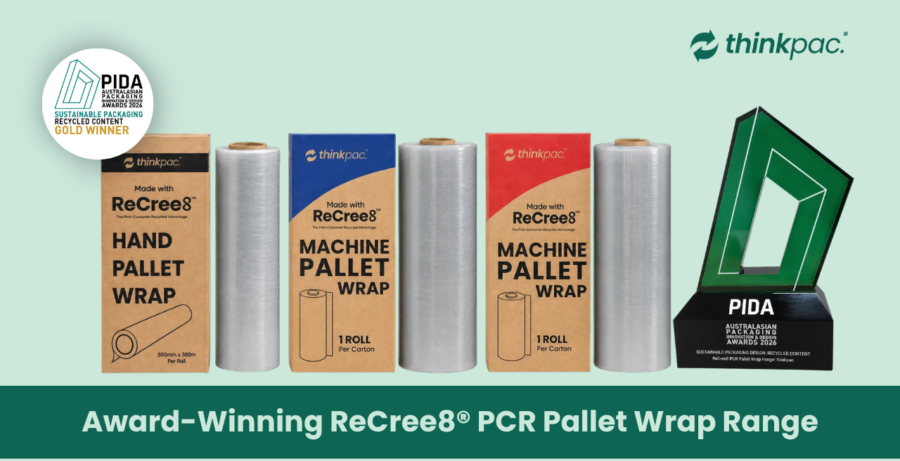
Over the last 12 months, thinkpac has expanded the ReCree8® PCR bin liner range to cover the two scenarios where degradable bags have historically been specified.
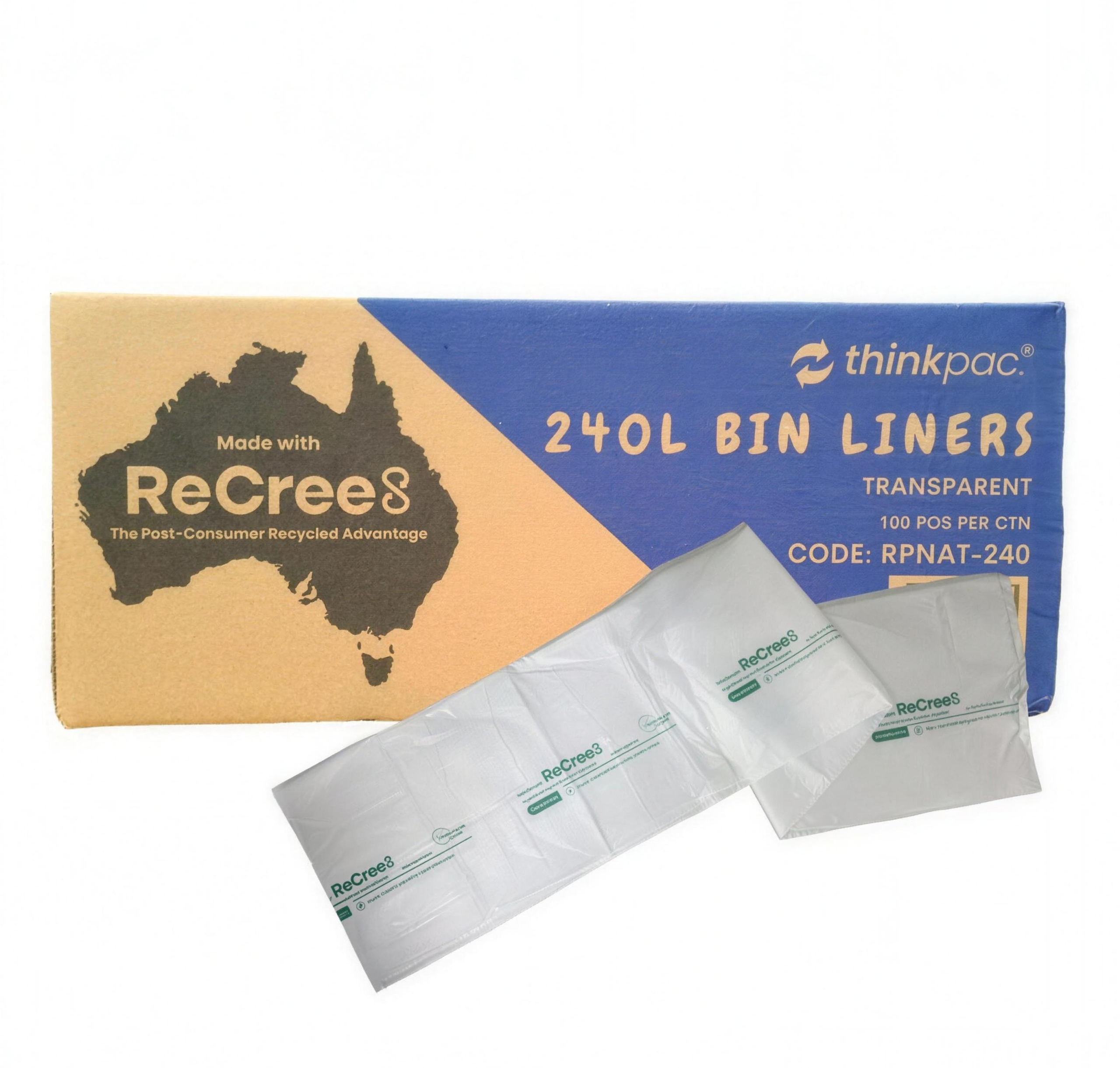
ReCree8® RPNAT Transparent PCR Bin Liners
Established Range The direct replacement for oxo-degradable bin liners in councils, art centres, and high-traffic public venues. Made with ReCree8®️, a 100% post-consumer recycled resin. Transparent, durable, and already deployed at scale across multiple Australian venues. GECA Verified · GRS Certified · RecyClass View product →
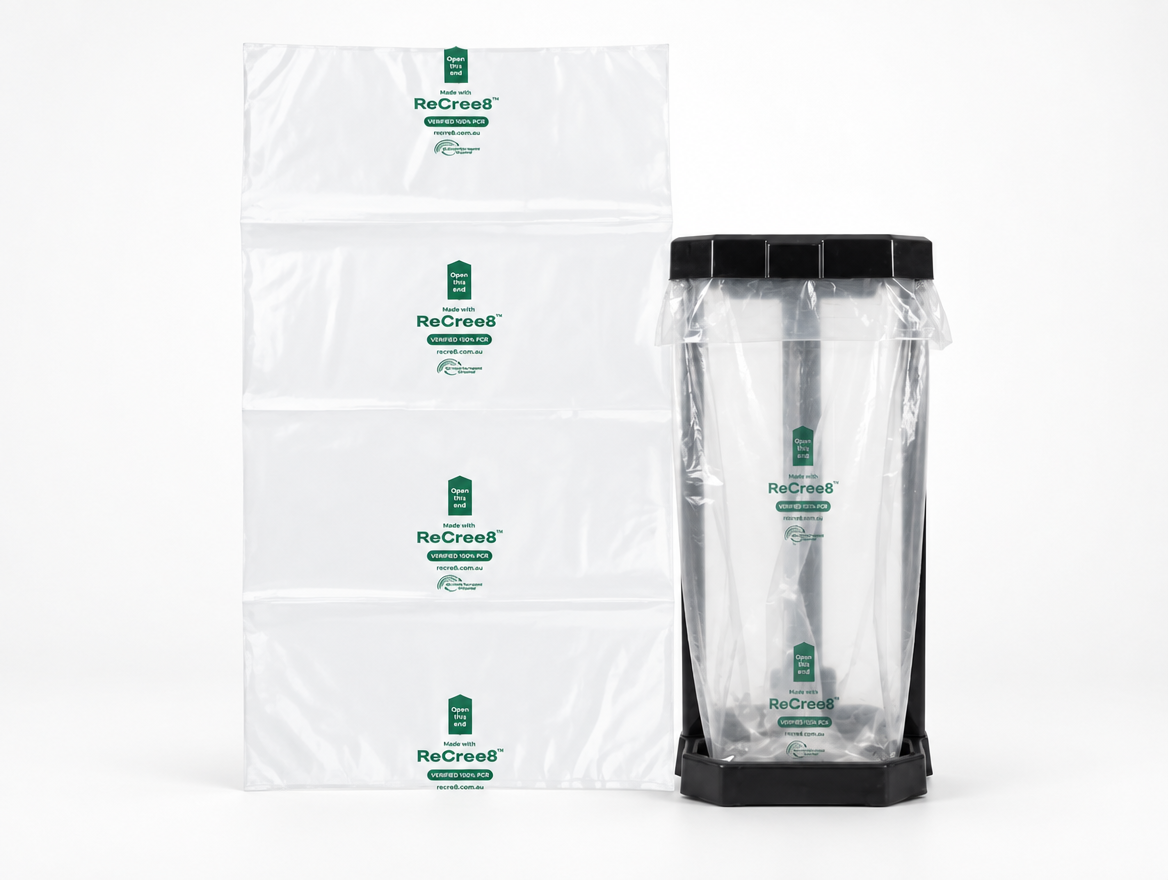
ReCree8® PCR Clear LDPE Bags
New in 2026 Australia’s first clear bin liner made with 100% verified PCR resin. Designed for venues that require content visibility — airports, convention centres, universities, stadiums. Available in 80L, 120L, and 240L. GECA Verified · GRS Certified · RecyClass · ISO 14001 Request a sample →
Both ranges are manufactured using ReCree8® resin — a proprietary post-consumer recycled resin produced from soft plastic waste collected, cleaned, and reprocessed at a GRS and RecyClass certified facility. Unlike recycled content blends where the percentage is estimated or self-declared, every ReCree8® product carries independently audited, traceable recycled content.
ReCree8® is the only bin liner resin in Australia with GECA claim authentication — meaning the recycled content claim is independently verified, not just printed on a label.
What the numbers look like in practice
The concern most procurement teams raise when switching from degradable to PCR is cost. The honest answer is that ReCree8® PCR bin liners are price-competitive with mid-range degradable products — and when you factor in the risk premium of ongoing regulatory exposure, the economics shift further.
The Melbourne Metro Councils network switched from oxo-degradable bin liners to ReCree8® RPNAT over a 12-month period. The environmental impact of that single network across one year:
Case Study
Melbourne Metro Councils — from oxo-degradable to 100% PCR
A large network of Melbourne metro councils needed a replacement for their oxo-degradable bin liners following regulatory scrutiny and a clear signal that bans were coming to Victoria. The requirement was a credible, certified alternative that wouldn’t add cost pressure.
thinkpac supplied ReCree8® RPNAT transparent PCR bin liners through a leading Melbourne cleaning distributor. Over 12 months:
Environmental impact calculated via ISO-backed methodology. Full case study available on request.
On verified impact data and ESG reporting
One practical advantage of switching to ReCree8® that procurement teams often underestimate is access to ISO-backed environmental impact data. Every ReCree8® order comes with verifiable data on CO₂ avoided, water saved, energy saved, and virgin plastic displaced — scalable to the volume purchased.
For organisations with mandatory or voluntary ESG reporting obligations — increasingly the case for any organisation of meaningful size in Australia — this data feeds directly into sustainability reports, NABERS submissions, and tender documentation. Degradable bags produce no equivalent data, because there is no verified environmental benefit to report.
thinkpac’s ReCree8® Impact Calculator allows procurement and sustainability teams to calculate the specific impact of switching to ReCree8® at their volume before making a purchasing decision.
How they compare
| Feature | Oxo-Degradable Bags | ReCree8® PCR Bags |
|---|---|---|
| Material origin | Virgin plastic + pro-degradant additive | 100% post-consumer recycled |
| End-of-life outcome | Fragments into microplastics | Circular — made from recovered waste |
| Regulatory status | Banned or restricted in QLD, SA, WA, ACT | Compliant — future-proof |
| Third-party verification | None | GECA, GRS, RecyClass, ISO 14001 |
| ESG reporting data | Not available | ISO-backed data per order |
| Tender-ready | No | Yes — spec sheet and tender clause available |
| Greenwashing risk | High — ACCC flagged | None — independently audited claims |
What to do if you’re currently using degradable bags
If your organisation — or one of your clients — is currently purchasing degradable or oxo-degradable bin liners, the practical path forward is straightforward:
Step 1: Identify which products in your current range are degradable
Check for “oxo-degradable,” “degradable,” or “EPI additive” on product labelling or data sheets. If a product claims to biodegrade without specifying a certification standard (EN 13432, AS 4736) and a verified composting environment, treat it as oxo-degradable until proven otherwise.
Step 2: Request a sample of the ReCree8® RPNAT or PCR Clear LDPE range
The transition from a degradable liner to ReCree8® is operationally straightforward — the products are dimensionally comparable, the strength is equal or better, and the performance in commercial environments has been validated across multiple high-volume Australian venues.
Step 3: Use the impact calculator to build the business case
If you need to present a switch internally or to a client, the ReCree8® Impact Calculator produces the environmental data you need to justify the change — and the numbers are independently verifiable, not marketing estimates.
Step 4: Request the enterprise specification sheet
For organisations that need to include PCR bin liner requirements in tender documents or supplier contracts, thinkpac provides a tender-ready specification sheet with a copy-paste clause covering GRS certification, GECA verification, and supply chain traceability requirements.
Ready to replace your degradable liners?
Request samples, download the specification sheet, or speak to our team about the right ReCree8® product for your venue or contractor operation.